
Find the Right Process & Combination for You

Rock powders

raise and maintain soil pH
provide mineral nutrients
improve plant nutrient-use
stabilise soil organic carbon
retain water & nutrients
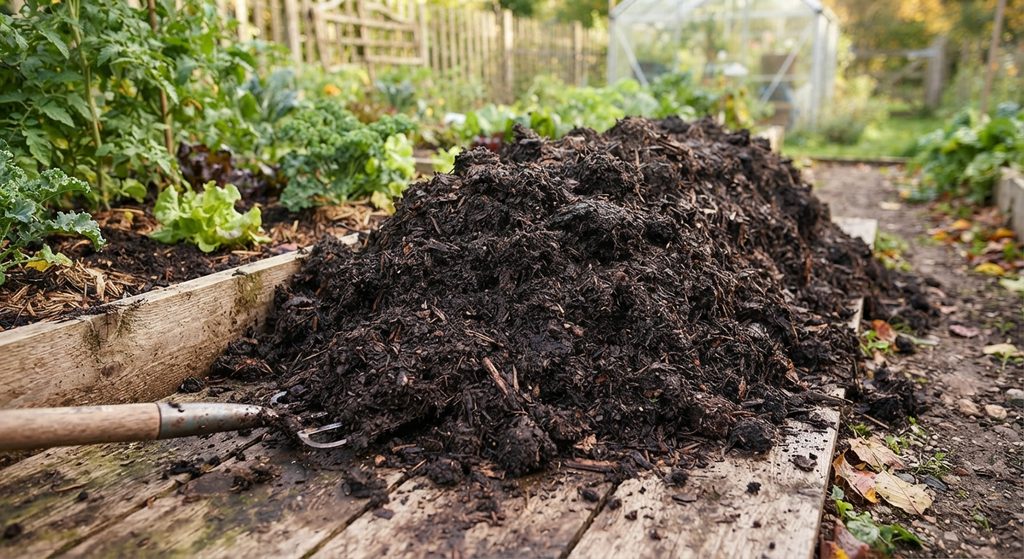
biostimulating compost
stimulate plant growth
provide organic nutrients
improve soil structure
enrich soil organic carbon
retain water & nutrients
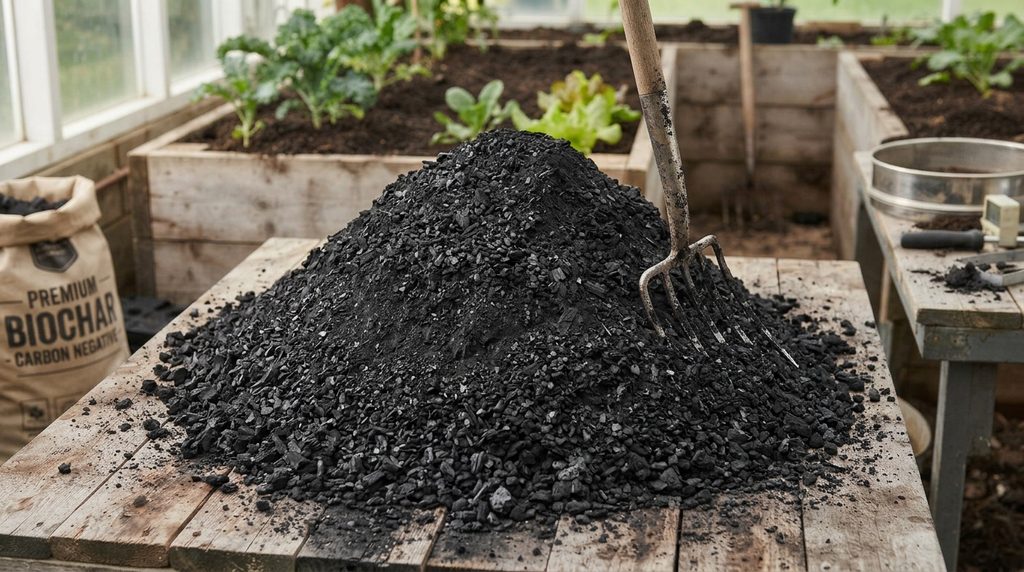
biochar
raise and maintain soil pH
host benign microbes
immobilise heavy metals
store stable carbon
retain water & nutrients
AMPI/Onirik experience
full synthetic NPK replacement at lower cost for specific conditions*.
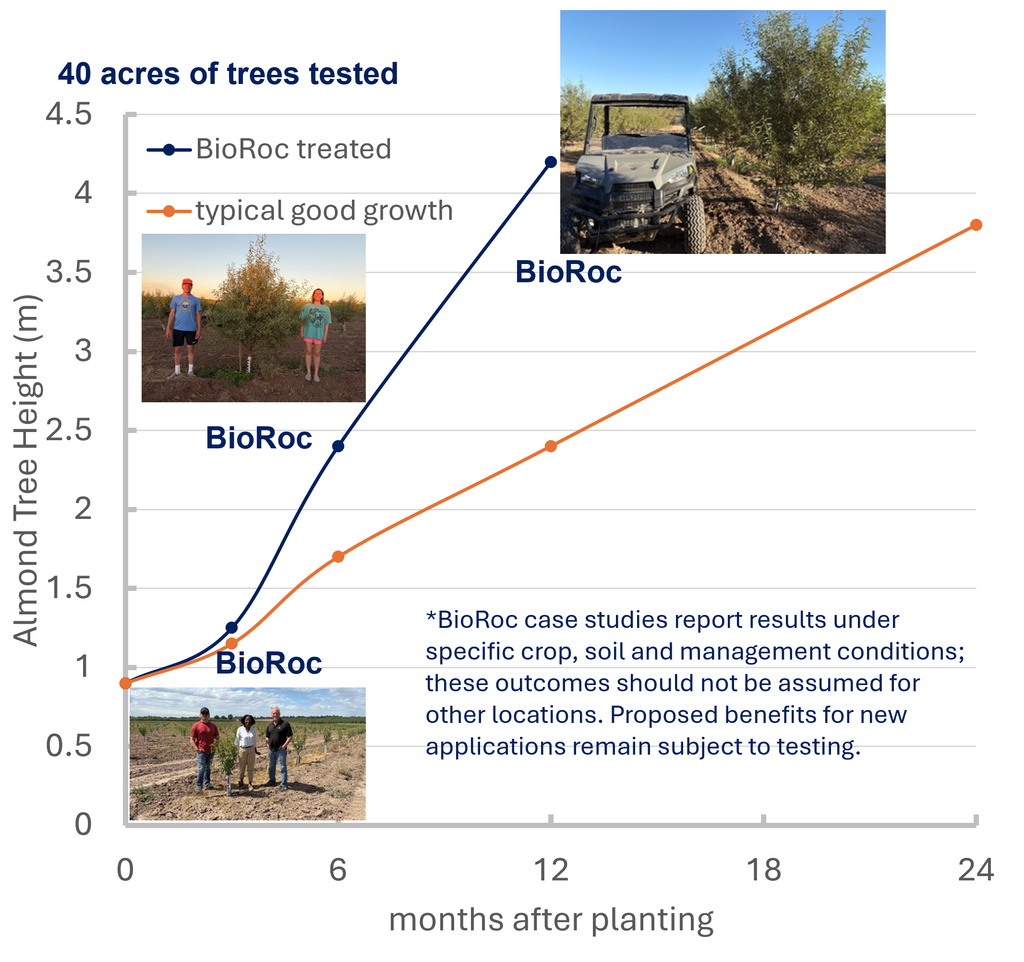
Jack Bauman Almond Orchards, California
New Trees
replanted after nursery
twice the early growth
as compared to conventionally treated trees,
with expected early onset of production
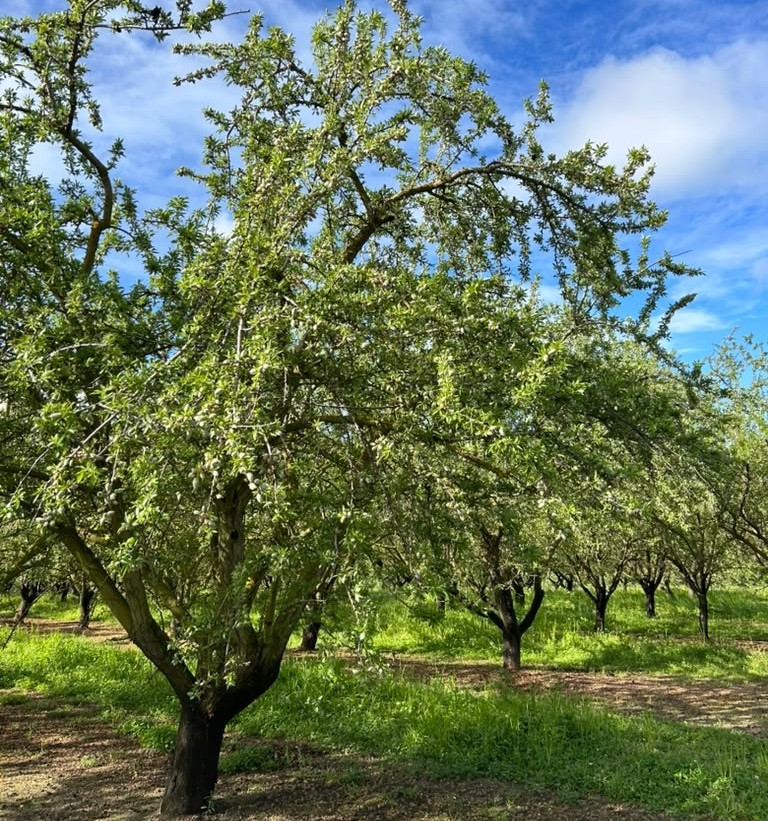
Aged Trees
previously considered for removal
improved ~88% annual yield
with extended production life
Other AMPI/Onirik’s BioRoc experiences include Franzia vineyards, soy bean, sorghum, pasture, with improved plant health and productivity.
State-of-the-Art?
In scientific literature, most studies cover only one specific category, such as agronomic benefits from enhanced rock weathering (ERW) or biochar.
Due to different core interest, we consider most commercial ERW projects for inorganic carbon sequestration overdose the rocks than what is needed for optimal agronomic benefits.
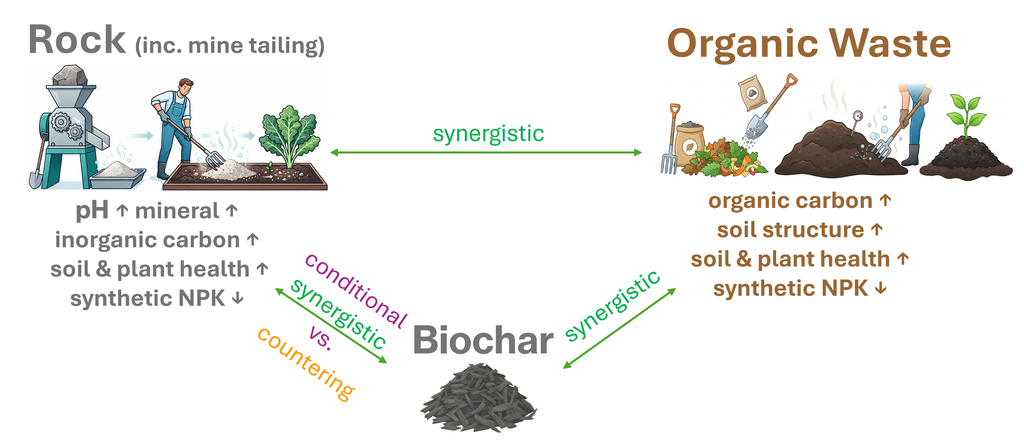
Some studies explore technology integration, such as rock-amended compost or mineral-enriched compost. Combination between rock and biochar was reported only in few studies.
Rock + Organic Waste for Mineral-enriched Compost
| Proven | phosphate-enriched compost |
| Well-studied | P, K enrichment from co-composting silicate |
| Under-studied or kept secret | – bioavailable Si enrichment – process optimisation |
Rock + Biochar
limited studies with different findings
- combination of the two may lead to additive effects of agronomic benefits (Honvault et. al. 2024; Vienne et. al. 2026), but also potentially cancel the crop-yield benefit each component delivers (Gong et. at. 2026).
combination of the two may lead to additive effects of agronomic benefits (Honvault et. al. 2024; Vienne et. al. 2026), but also potentially cancel the crop-yield benefit each component delivers (Gong et. at. 2026).
– Agrocknomy believe we know why and how to optimise the integration to create synergistic effect — and we think AMPI/Onirik already knew and had tested it.
Market Viability
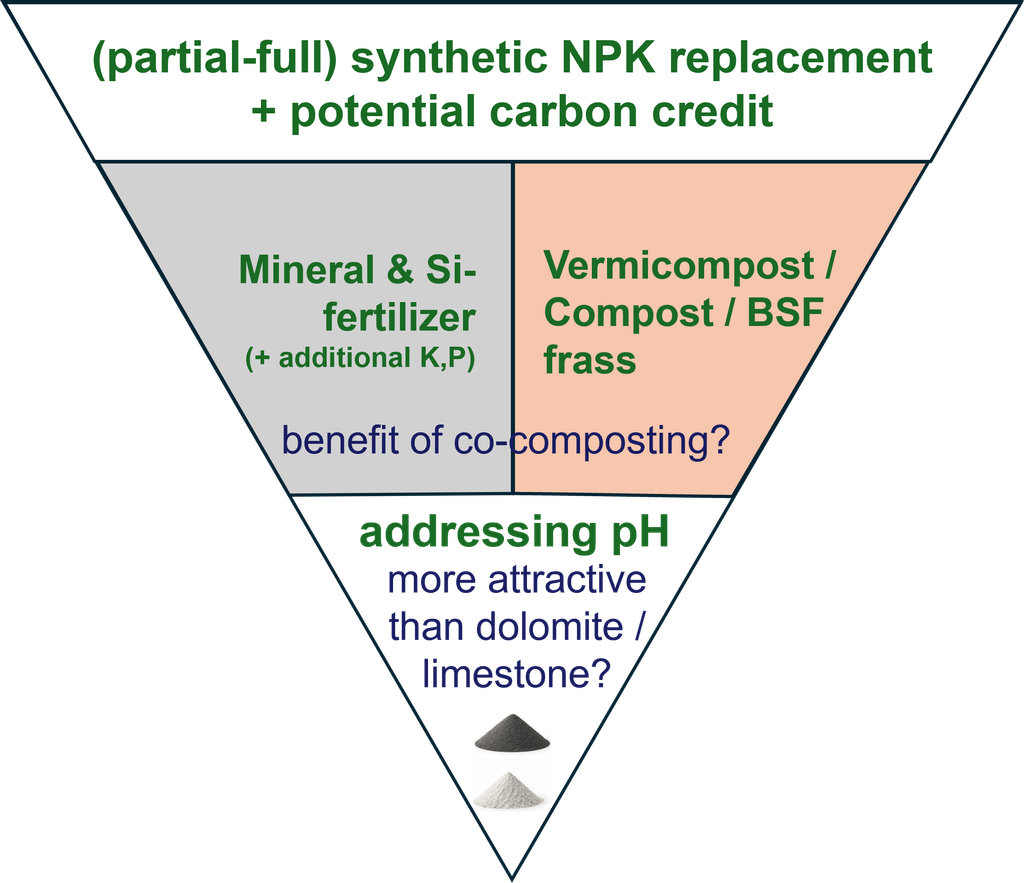
Opposite to the soil acidity-to-crop problem triangle where soil acidity is merely the fundamental phenomenon of many other soil and crop problems, addressing the pH problem only with our solution is with minimal market viability (as shown in the reverse triangle), while additional benefits from minerals and biostimulating compost further improve the market viability (as shown in the upper layers of the reverse triangle).
Considering only the pH, slow-dissolving silicate provides a systemic pH stabilisation with improved soil pH buffering capacity. This is in contrast of conventional cyclic liming with fast-dissolving limestone or dolomite that releases conservative cations too quickly, leading to substantial “alkalinity-loss” after the “alkalinity shock”, which also catalyses nitrification and nitrate leaching (Grzebisz et. al. 2026). The better “alkalinity-use-efficiency” of silicate rocks for pH maintenance thus requires lower dose per replaced limestone or dolomite (i.e. replacement ratio, RR), as compared to initial pH correction. With some regions where basalt only costs around US$10 t-1, it will be more price competitive than dolomite (see below figure).
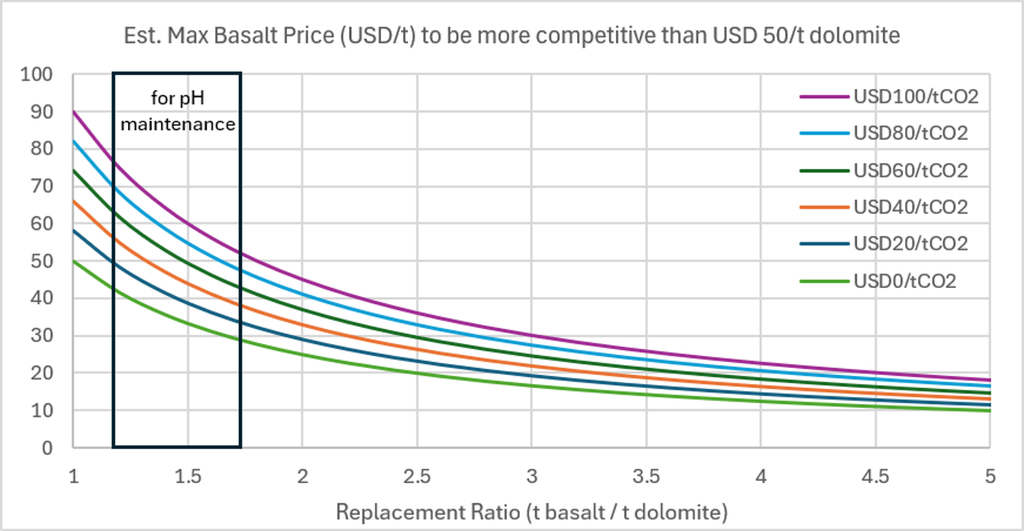
Using basalt, the most used silicate rock as the example, the figure shows the maximal competitive basalt price ($B) to replace USD 50 t-1 dolomite ($D). The boxed replacement ratio RR is our hypothesized range for pH maintenance purpose. Conservatively, we suggest using $CO2 = 0 (no carbon credit revenue) so the basalt price needs to stay below the lowest green curve. The other scenarios with non-zero $CO2 are based on a preliminarily estimated relationship $B ≤ ($D +0.4$CO2)/RR or $B ≤ ($L +0.4$CO2)/RR, where 0.4 implies a conservative estimate of reduced CO2 emission at 0.4 t CO2 per ton of replaced carbonate (e.g. limestone or dolomite), as compared to IPCC guideline of 0.44 t CO2 per ton limestone and 0.48 t CO2 per ton dolomite, taking into account of potential carbonate impurities in the basalt.
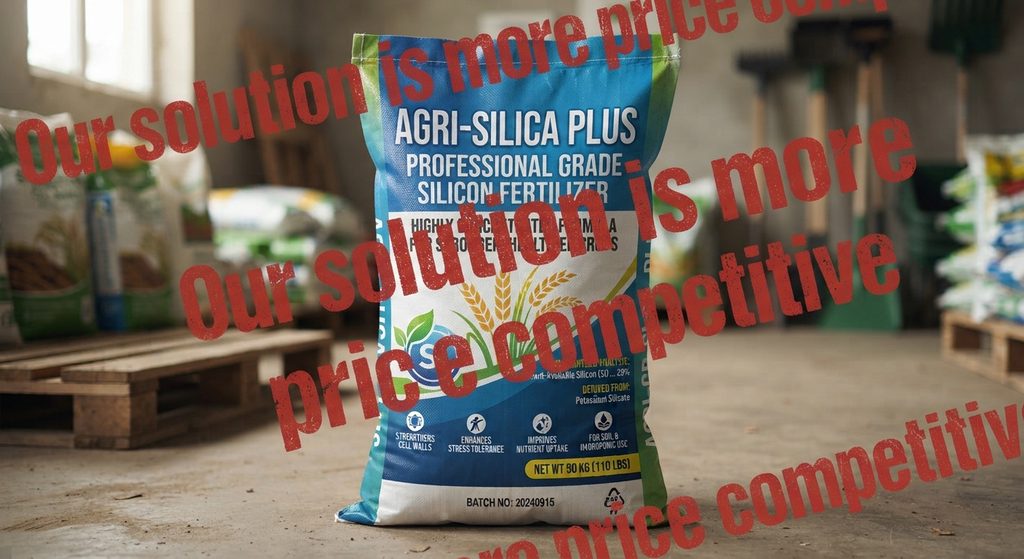
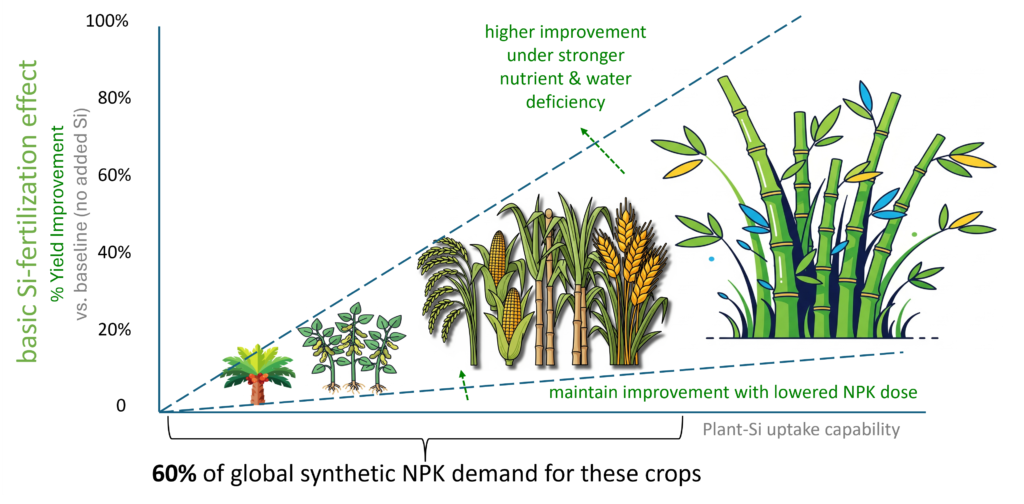
Commercial Si-fertiliser can cost US$100-500 for bulk order, and typically > US$1500 for retail price. International shipping can add to further price hike. Our solution focuses on local production at the country where farms are located, maximising resource circularity and minimising logistic cost, and possibly narrowing down the bulk-purchase and retail price gap. Even if we consider the lowest possibly silicate fertiliser price at US$100, and a replacement ratio RR of 3 for silicate rock, the local silicate rock just needs to be at a price below US$33. This sample calculation needs to be recalibrated for specific local prices of Si-fertiliser and silicate rocks (which will likely make our solution even more competitive).
Most importantly, such calculation has not factored in the synergistic effect that Si-fertiliser alone may not be able to provide. After all, AMPI/Onirik’s past experience suggested potential full synthetic NPK replacement at lower cost, though its performance for tropical condition has to be validated.
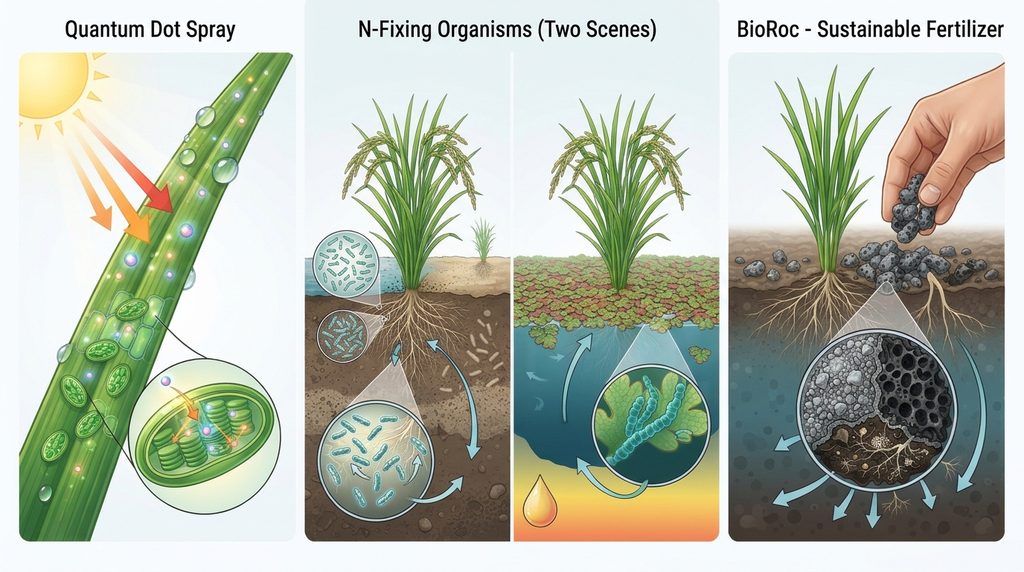
As our solution focuses on improving soil health with local rock (mineral) supply with proper blending of biochar and organic nutrients, biological-based solution provider are more like synergistic technology provider other than commercial competitors. Such synergistic integration can potentially further improves the crop yield and minimises synthetic NPK dependence. For example, quantum dots that converts daylight into photosynthesis-focused red light, improves photosynthesis efficiency, but also creates stronger nutrient demand. N-fixing organisms, such as Xanthobacter autotrophicus, Cyanobacteria, and Azolla, under different conditions, allows on-farm N-fixation for crops. As we have experience achieving summer rice yield ~ 11 tonne per hectare in subtropical region with good and long daylight hours (average Southeast Asian rice yield < 5 tonne per hectare), combination of our technologies can potentially achieve similar rice yield per harvest in tropical region, with low synthetic NPK demand.